

Lando Norris and the hero’s journey
Most people who know me are aware that I’m a very committed Formula 1 fan. Committed enough that I’m up at 5am every second Monday to watch a race before work (Southern Hemisphere fans unite in sleep deprivation!)
It’s funny being a motorsport fan as a woman. Men usually assume I’m in it for the drivers and don’t have any wheel knowledge. Meanwhile I’m poring over the telemetry and watching strategy deep dives — but don’t worry — this post isn’t about the baseline misogyny within male-dominated sporting fandoms. It wasn’t actually aerodynamics, engines, or babes that got me into F1. It was stories.
The first Covid lockdown had just begun when my husband suggested we watch the F1 docuseries Drive to Survive. I was F1 adjacent before that, in that I used to live in Melbourne and had been to watch the race a few times, years earlier, but I didn’t know much about it other than the name Lewis Hamilton. An icon. Our son was 18 months old at the time and he hated sleep, so a time-sucking spectator sport that necessitated being up in the middle of the night was a perfect fit for us.
The first season of Drive to Survive was a masterclass in providing narrative entry points to a complex sport. I discovered there was so much more to care about than who was on the podium. There were heroes and villains, titans and fools, politics, pettiness, and powerplays. Formula 1 really has it all — an entire narrative universe.
I was hooked, and by that I mean I dove deep. I followed engineers, strategists and pundits on Instagram, knew the names of the most promising junior drivers in the feeder series, was all over the paddock gossip before the BREAKING announcements dropped. It was during my time in these depths that I found my driver. The one I wanted to follow: Lando Norris. He’s half British, half Belgian. He drives for McLaren. He’s a lad.
Lando Norris is an unexpectedly polarising character in the F1 fandom, particularly during the last couple of years when McLaren’s had a dominant car. People accuse him of being both arrogant and lacking in confidence. They say he’s too nice, not aggressive enough, too emotional, too easily affected by criticism. People say the team favours him and that the commentators and stewards have a British bias. People love to say that Lando doesn’t have the mentality to be a world champion. And yet, he’s going into the final race of the season this weekend with a 70% chance of winning it all.
It's too simplistic to call Lando an underdog — because how can a wealthy white dude in the fastest car be an underdog? I’ve been trying to figure out what it is about Lando’s story that reeled me in and I’ve realised: he’s on a hero’s journey.
The hero’s journey is one of the foundational structures of human narrative that was first documented by an American mythologist called Joseph Campbell in the 1940s. He called it the ‘monomyth’, because it was a narrative structure he saw recurring in myths and legends from cultures all over the world. The monomyth was expanded upon and systemised in the 1980’s by Christopher Vogler, a screenwriter at Disney. Even if you’re not familiar with the beats of the hero’s journey, you absolutely will know stories that contain one: Star Wars, Harry Potter, the Hunger Games, the Lion King — just to name a few.
The structure is always the same:
Our hero leaves the familiar world
Is tested
Gains knowledge or power
Returns transformed
Sport is the perfect vehicle for the hero’s journey. From Cathy Freeman to Simone Biles, every athlete has a hero’s arc waiting to unfurl. Case-in-point is my favourite sporting story of 2025: golfer Rory McIlroy’s long-awaited Master’s triumph.
Rory was a lovable Irish prodigy who rose quickly on the PGA tour following his debut in 2007. He won his first 3 majors over a 4 year period from 2011-2014. All he needed to do to take out a career Grand Slam was to win the Masters at Augusta and he’d join the ranks of golfing legends like Tiger Woods (one of only 5 men to do it).
But Augusta became Rory’s nemesis. He just couldn’t beat it. He faced years of struggle, near-misses, heartbreak, and public expectation. In 2025 — more than a decade after he began his quest — he finally got the job done, winning Augusta and completing the Grand Slam. In doing so he cemented himself not only as a hall-of-fame champion, but as one of the great sporting examples of resilience and redemption.
It was a beautiful thing to witness, I cried watching that nerve-racking play-off with Justin Rose and, honestly, I don’t even watch golf or care about it particularly? That’s the power of the hero’s journey.
I got hooked on Lando’s story by accident. Drive to Survive didn’t set him up as a protagonist at all, more of a bit-part. Season 1 was all about Daniel Ricciardo’s journey: leaving Red Bull to find his destiny at Renault (eeesh that turned out to be a cautionary tale). But if you focus on Lando from his rookie season in 2019 until now, his career has all the hallmarks of the hero’s journey:
1. Our hero leaves the familiar and enters the unknown
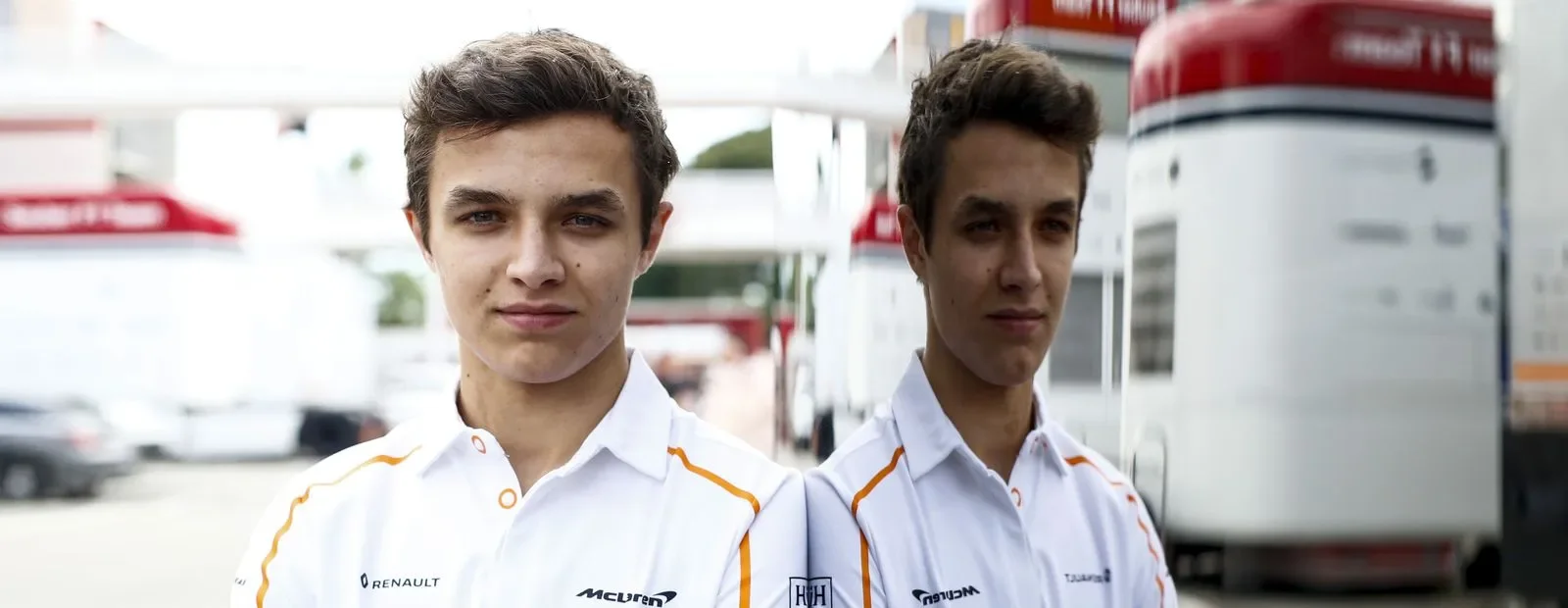
Lando was a babe in the woods, entering the big wide world of Formula 1 as the youngest British F1 driver in history at just 18. He was still considered a junior driver two years later when Daniel left Renault to join McLaren. The idea was that the pint-sized Brit would learn from the 7x grand prix winner just as he’d learned from Carlos Sainz before him. But then the unexpected happened: Lando out-drove Daniel. He unfurled into a potential champion while the promise of Daniel’s redemption arc withered away.
2. Our hero is tested through a series of trials
Then he arrived on struggle-street. Things went right, but more often they went wrong. Sometimes it was Lando’s fault. Sometimes it was the team’s. He came so close to winning a number of times only to have it cruelly taken away. He managed to rack up 14 podiums while the internet nicknamed him Lando No Wins. He was all about self-flagellation in interviews. Nico Rosberg DMed him and told him to find a sports psychologist.
3. Our hero gains knowledge or power
2023 started out looking bleak for McLaren. The car sucked. They were pretty much a back-marker at the first race, but a major upgrade package halfway through the season worked like a miracle, and they were suddenly back up at the pointy end of the grid.
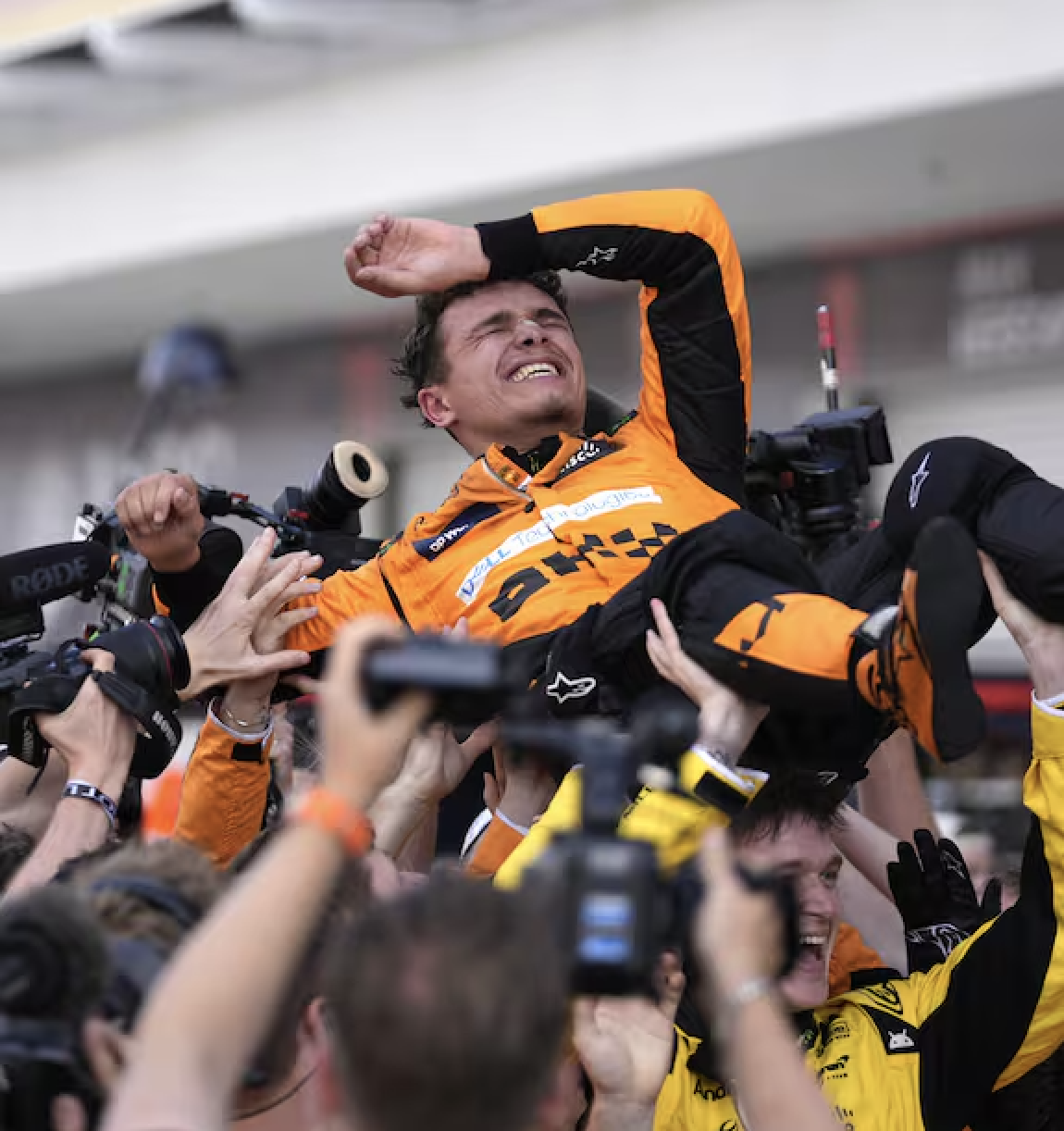
I love that he had stitches on his nose for his first win because he accidentally smashed a glass into his own face the weekend before while partying with Martin Garrix. A clumsy and unserious king.
Even with the right machinery, it still took Lando 6 months to win a race. He won the 2024 Miami Grand Prix on pure pace (and one well-timed safety car). A legendary drive. It’s the only time I’ve ever cursed the friendlier US time zone, as I tried to do the school drop-off while glued to my phone. I cried watching Lando’s first win from a carpark in downtown Auckland. He made me late for a meeting. I can’t embed this video of his team radio after the win because Formula 1 are psycho about content, but you should watch it for the vibes.
Lando almost won the championship last year, but Max Verstappen and his Red Bull were too good. It was a hectic and drama-filled season. Lando made progress, but Max got in his head and won the mental game.
4. Our hero returns transformed
In 2025 Lando did appear transformed — maybe he got that psychologist? Maybe he deleted all the social media apps from his phone? Something happened, because he was confident and at peace with his own way of doing things.
He’s driven brilliantly but not perfectly this season. It’s been a tricky time to be a McLaren fan (I’ll tackle the outrageousness of ‘papaya rules’ another day). Arguably, Lando should have won the championship before the final race, but instead he’s heading into Abu Dhabi this weekend with a 12 point lead over Max Verstappen, and a 14 point lead over his team mate Oscar Piastri (his hero arc is coming). All he has to do is finish on the podium and he’ll be crowned world champion. Can he do it? Is this his moment of redemption — the culmination of his hero’s journey? Or will we have to loop back to trials and tribulations for another season?
When sports stories don’t go my way I always tell myself it’ll just make the payoff better when victory finally comes. Think of the All Blacks 24-year World Cup drought. 2011 wouldn’t have felt so good if we hadn’t been made to wait two decades for it, you know?
What’s the reason for my unwavering belief in sports redemption arcs?
My own history has a sporting hero’s journey in it, which, if Inside Out were real, would be stored carefully as a golden core memory orb upon which my sense of self is built.
When I was 12 I signed up to play baseball with my best friend at the time, J—. We practiced at Madill’s Farm in Kohimarama. Our team were called the Cardinals and we wore royal blue shirts. We were the only two girls on the team. I played short stop. I wasn’t bad at fielding, but I was terrible at batting. Throughout the entire season I didn’t manage to hit the ball once. Not in practice or games. Our team was carried by a couple of exceptional batters (the coach’s son and his best mate). We were a great team but I was the squeaky wheel.
The day dawned on our own championship moment and we were poised to win the league. Our team was well up to the task of beating our nearest rivals, if it weren’t for the fact that their pitcher was a prodigy. He was so fast. I sat at the end of the batting order watching as he took out our best players one after another. Then it was my turn to step up to the plate. I could almost feel the collective sigh of defeat from my team as I walked out. The best pitcher in the league against me? We were so screwed. He pitched. I missed. Strike 1. He pitched wide twice. Ball. Ball. Then strike 2. Then another ball. It was a full count and I had one more chance. I swung. I struck. I ran.
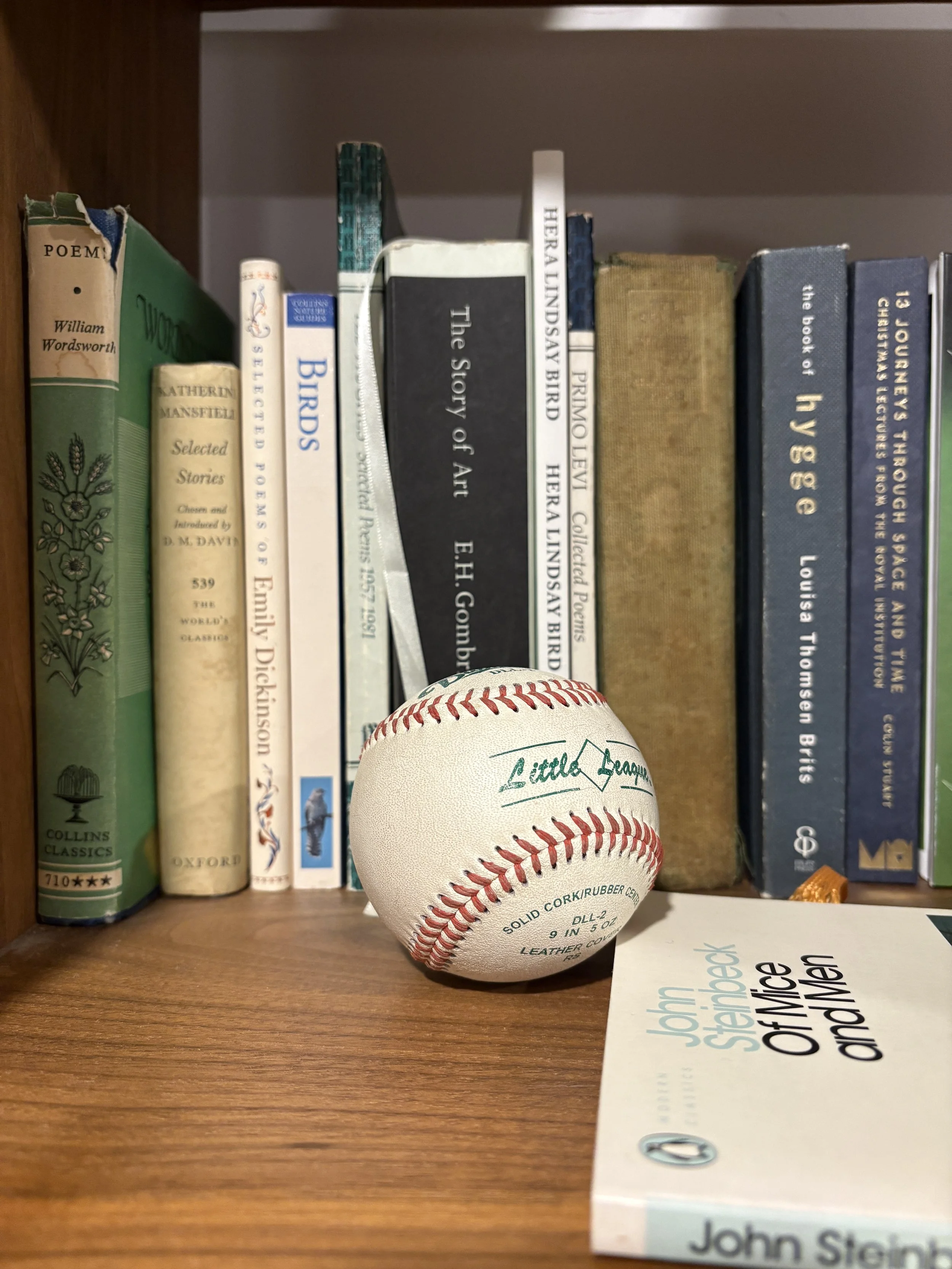
I made it to first base and our order re-started. The sound of our team cheering is still with me even now. The coach’s son stepped up to the plate and hit a home run. He wouldn’t have had the opportunity if it hadn’t been for my moment of glory, and the whole team knew it. I turned the tide of the game. We won the championship. I was awarded player of the day and given a shiny new baseball to take home and keep forever as a reminder that it’s never too late to hit the ball.
What I mean by that is: the stories we tell ourselves about what we’re capable of don’t matter when a moment of action presents itself, unless we allow them to. Every moment is an opportunity to shape a new story.
It’s proven a powerful mantra for me, and I still mutter those words to myself in moments of struggle. I still look at that baseball sitting on my bookshelf and think about the moment when 12 year old @courtpet proved she could change the narrative, break the cycle, be the hero.
I’ll be muttering it to myself again this weekend when the lights go out.